Introduction
As AI tools like ChatGPT become increasingly common in classrooms, educators need thoughtful strategies to determine when and how to use them. This framework encourages reflection on choices using key questions regarding purpose, fairness, learning, and values.
Learning Objectives
- Understand what the AI Assessment Scale (AIAS) is and why it matters in teaching.
- Use the reflection framework to think about how and why they might allow AI in classroom tasks.
- Ask important questions about fairness, learning, and values when using AI tools.
- Make informed choices about AI use that match their teaching goals and responsibilities.
AI Assessment Scale (AIAS)
The AI Assessment Scale (AIAS) is a practical framework designed to help educators determine appropriate levels of GenAI use in assessments, ranging from “No AI” to “Full AI” integration. It aims to balance the opportunities and challenges of GenAI, providing clarity, transparency, and fairness for students and institutions (Furze et al., 2023).
Figure 1. Five Levels of the AI Assessment Scale (AIAS), adapted from Perkins et al. (2023).
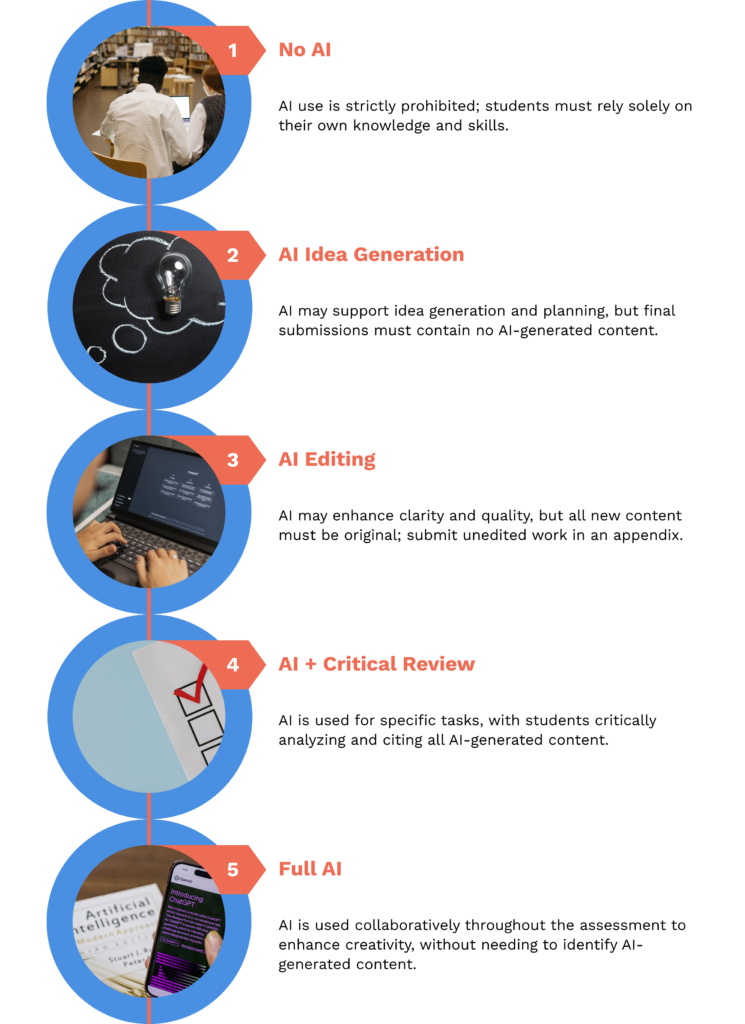
Note. Shahram Fardadvand (2025) generated this image using the Piktochart platform. I dedicate any rights I hold to this image to the public domain via CC0.
Philosophy-Aligned AIAS Reflection Framework for Teachers
As teachers navigate the evolving role of generative AI in education, they are called not only to make practical decisions but also to engage with deeper pedagogical, ethical, and philosophical questions.
The Philosophy-Aligned AIAS Reflection Framework assists educators in making careful and principled decisions regarding the use of AI tools in teaching and assessment. Based on the AI Assessment Scale (AIAS) developed by Perkins et al. (2023), this framework broadens the discussion to encompass essential philosophical dimensions: ethics, logic, realism, and epistemology.
Instead of simply asking, “Is AI allowed?”, this tool encourages educators to consider:
- Why might AI be beneficial for this task?
- What assumptions does it make about learning?
- Who benefits from it, and who may be overlooked?
Each dimension in this framework invites teachers to pause, question, and reflect on how AI is shaping their classroom practice. It supports educators as critical stewards of learning, helping them align technology use with their values, professional judgment, and the ethical demands of teaching.
Table 1. Philosophy-Aligned AIAS Reflection Framework for Teachers
| Dimension | Description | Guiding Question |
|---|---|---|
| Intentionality | Focuses on the why behind using AI in your teaching. Encourages teachers to consider whether the AI use serves meaningful learning goals or simply responds to trends, convenience, or pressure. | What is the purpose of using AI in this context? Does it support your pedagogical goals (e.g., efficiency, creativity, inclusion)? |
| Transparency | Examines whether teachers and students can understand how the AI tool works, what data it uses, and how its outputs are generated. Encourages open dialogue and responsible disclosure. | Are you and your students able to understand how this AI functions or how it generates suggestions? |
| Impact on Learning | Asks how AI affects student learning, agency, and development. Prompts teachers to consider whether AI fosters deep learning or creates shortcuts that reduce meaningful engagement. | Does AI enhance or reduce student learning, agency, or cognitive development? |
| Ethical Fit | Encourages teachers to consider if the tool aligns with their values and responsibilities. Highlights risks such as bias, surveillance, inequity, and over-reliance that could compromise the integrity of teaching. | Does this tool match your professional values? Do you have any concerns about bias, surveillance, or relying too much on it? |
Learning Activity: Intentionally
Note. Shahram Fardadvand (2025) generated this activity using the H5P platform. I dedicate any rights I hold to this activity to the public domain via CC0.
References
Furze, L., Perkins, M., Singapore, J., University, D., Roe, J., & Vietnam, J. (2023). The Artificial Intelligence Assessment Scale (AIAS): A Framework for Ethical Integration of Generative AI in Educational Assessment. Journal of University Teaching and Learning Practice. https://doi.org/10.53761/q3azde36
Furze, L., MacVaugh, J., Perkins, M., & Roe, J. (2024). The AI Assessment Scale (AIAS) in action: A pilot implementation of GenAI supported assessment. ArXiv, abs/2403.14692. https://doi.org/10.14742/ajet.9434
Acknowledgement
The author of this chapter acknowledges the use of ChatGPT, GPTs for generating examples and summarizing some readings, Grammarly for checking grammar, and Piktochart for generating infographics.